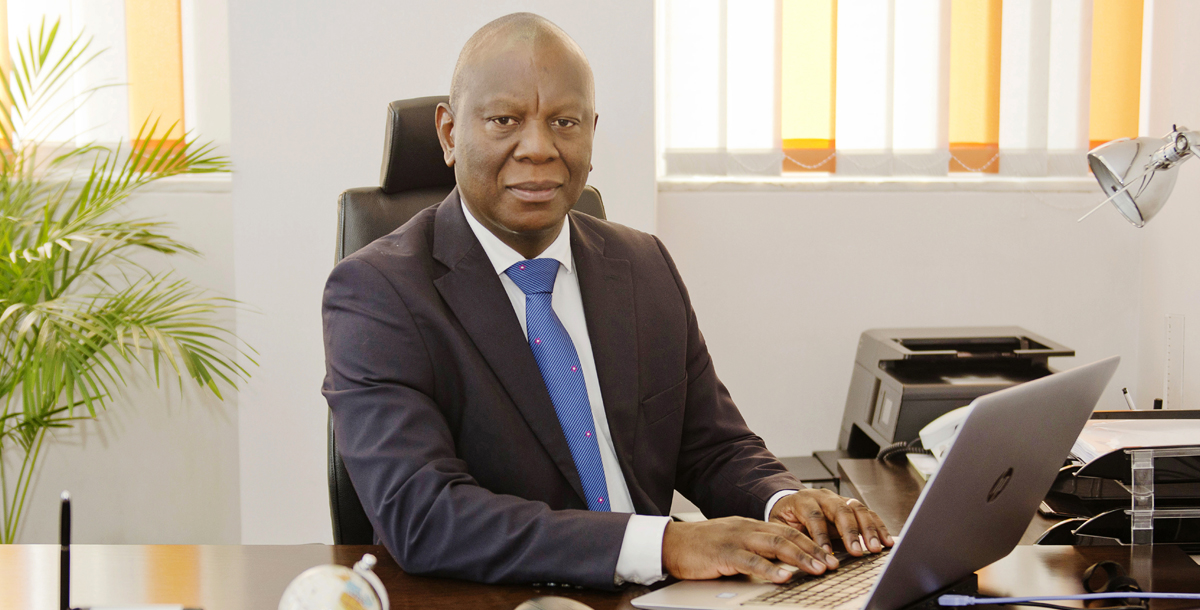
30 Jul Interview with Helder Chambisse, Chairman & CEO, Petromoc
As the largest fuel distributor in Mozambique, Petromoc occupies a central position in energy security. What is your strategic vision for Petromoc and what immediate priorities are shaping the company’s development in the current energy context.
At this moment, the company’s operations are normalized and stable. We are operating with a market share of 25%. At this moment, our strategic approach is to increase our storage capacity in order to expand the country’s strategic reserves. To ensure that we have sufficient fuel available at any time, which then protects the country from any external shocks, whether in the international fuel market or internal shocks, such as foreign currency availability or exchange rate fluctuations, for example. So our approach at this time is to increase storage capacity, therefore the country’s logistical capacity, in order to have sufficient strategic reserves.
The second aspect is to consolidate our retail network. At this moment, we have a retail network of more than 200 service stations. We want to keep this retail network fully operational and expand it in strategic locations in order to increase our reach to customers. Within the retail network, we are also seeking diversification. Looking now at the issue of the company’s profitability, we are looking at our retail network and diversifying the services we offer, not only fuel, but increasing the non-fuel component in the company’s revenues. This will help stabilize revenue generation and have a positive impact on our profitability.
Therefore, the overall strategic vision is to keep Petromoc relevant in the market in terms of ensuring fuel supply, securing the logistical capacity for that supply and diversifying revenue sources to increase the company’s profitability.
Despite significant investments in hydroelectric energy and LNG exports, petroleum products continue to be essential for transport, logistics and industrial activity in Mozambique. How do you assess the prospects for the fossil fuel sector in the country and what are the main factors driving demand in the domestic economy?
I believe fossil fuels will continue to be relevant in the country. We must keep in mind (and this is also reflected in the government’s objectives) the energy transition, with fossil fuels but with greater focus or some prioritization of conversion alternatives, whether biodiesel or increasing the use of gas produced in the country.
Fossil fuels will continue to be relevant for some time, not only because of their current scale. Replacing them entirely would be unrealistic, but also because of the investments required to significantly accelerate the energy transition. Demand also remains relevant. The largest fleets in the country that consume fuel are still based on fossil fuels, whether gasoline or diesel, although there has already been a significant increase in the number of vehicles powered by gas, both private and commercial, but the number is still relatively small compared to vehicles powered by fossil fuels.
With around 132 million gallons of fuel storage capacity across 19 depots and terminals nationwide, Petromoc supports Mozambique’s fuel supply chain. What are the main challenges in maintaining energy security and how is Petromoc strengthening supply reliability across the country?
Essentially, it is about consolidating this storage infrastructure. We have storage facilities at all the country’s main ports. The main challenge is to keep this capacity operational. The installed capacity is between 130-160 million gallons and our objective is to keep most of this capacity operational. This implies carrying out all the necessary preventive maintenance to maintain this infrastructure functional. This has already been done and then we look at specific cases where it is still possible to expand capacity.
We have some expansion projects. One that has already been completed is the Pemba Terminal, where we more than doubled storage capacity. We also have the Nacala Terminal and the Beira Terminal with space for expansion. At the Maputo Terminal in Matola, we brought into operation three tanks that had been inoperative since the 1980s, which increased operational capacity by more than 140,000 cubic meters.
Therefore, the most important thing is to focus on preventive maintenance of this infrastructure. Many facilities are old and require special attention in maintenance. Then we must continue investing in expansion and modernization of this infrastructure in order to guarantee safety, reliability and handling standards comparable to international best practices.
Mozambique’s energy strategy combines hydroelectric power, LNG, renewable energy and petroleum fuels. How does Petromoc position itself within this evolving energy mix, particularly as the country expands renewables and natural gas? How do you see the future of oil in the country?
As I said, it will continue to be relevant, but we must consider the need for transition. Petromoc is positioned to increase the use of gas in the country. We currently have active participation in cooking gas — LPG — with storage in Maputo and Beira. We have filling lines in Maputo, Beira and Nampula. We are also looking to invest in additional filling lines in Tete and Pemba.
We also have vehicle gas, where we play an important role in coordination with the government. We already have service stations supplying vehicle gas and we are currently investing in three additional stations in Gaza province and Inhambane province, where Petromoc stations, in addition to liquid fuel, will also supply vehicle gas, so although liquid fuels remain relevant in the country and in Petromoc’s activity, we are also playing an active role in this transition by increasing the gas component. One component is cooking gas, some of which is already produced locally by ENH from natural gas and we are part of that value chain. Then there is vehicle gas, where we also play a relevant role in the chain.
How is Petromoc using digitalization to improve processes?
Internally, in improving our management processes, we have increasingly digitalized processes, which allows us to increase efficiency in Petromoc’s operations. This obviously impacts the service we provide to our customers. We become much more efficient in dealing with customers, which has an impact on the service we provide and on the product supply we carry out. Not only internally in terms of document processing, but also operationally. For example, fuel dispatch from our terminals now has an increasingly strong digital component, which allows for faster turnaround at our terminals and increases operational efficiency.
From Petromoc’s perspective, what is the importance of Japan as a long-term energy partner for Mozambique?
There are two components. One is the exchange of experience and benefiting from the know-how of a more developed country with more efficient processes, which can allow us to improve our operational efficiency.
The second aspect is investment. We still have room for investment in Mozambique and investment in Mozambique does not look only at Mozambique, but also at the region. Investing in Mozambique allows gains in scale for investors because it also provides access to the region. Specifically for Petromoc, we still have several projects, not only for increasing capacity but mainly for modernizing our infrastructure. This will then allow us to serve the hinterland and neighboring countries with greater efficiency. Therefore, investing in Mozambique, investing in Petromoc, investing in Petromoc’s projects brings accelerated gains through regional access.
Looking ahead, how do you expect Petromoc’s role to evolve as the economy grows and the country balances fossil fuels with cleaner energy sources?
Petromoc will continue to be relevant and is positioning itself and must continue positioning itself to take advantage of business opportunities that will arise with growth, not only for its own profitability as a company, but also by driving this development. A strong, stable and well-positioned Petromoc will contribute to greater economic growth.
Our role is essentially to ensure that Petromoc is prepared first to take advantage of these business opportunities and second to serve the economy as it needs and in doing so drive economic and social development overall.
Our slogan says, “Petromoc always present.” We are present in driving the Mozambican economy. We are present in taking advantage of existing business opportunities. We are present in the energy transition, as conditions require reducing the role of fossil fuels and increasing the use of renewable energy. Therefore, Petromoc is always present.
Sorry, the comment form is closed at this time.