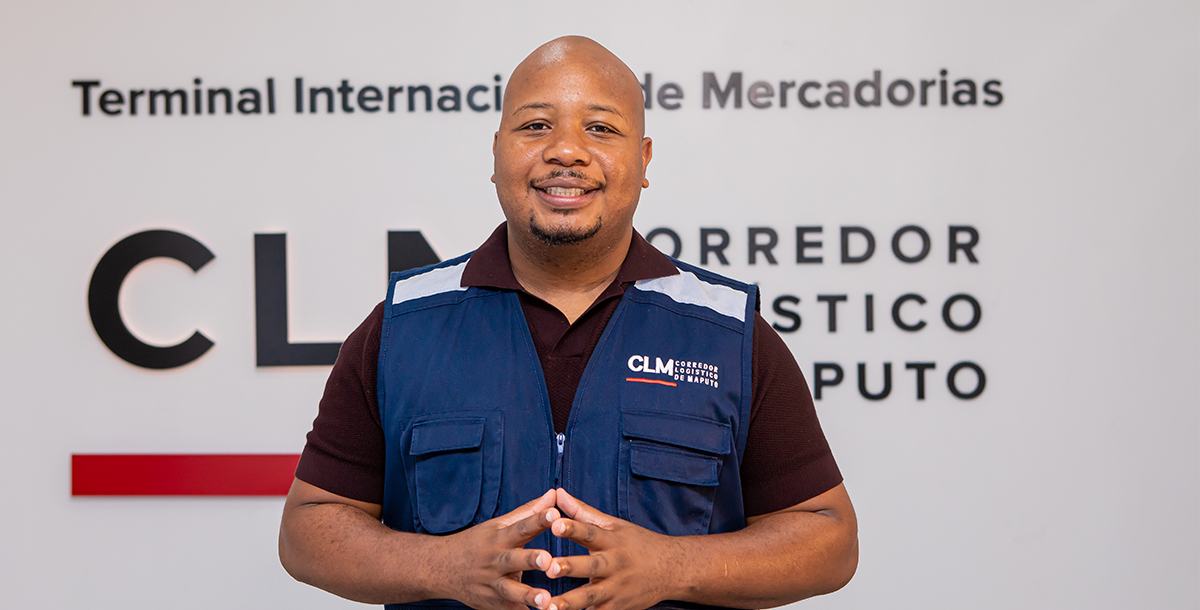
30 Jul Interview with Clávio Macuácua, CEO, Corredor Logístico de Maputo (CLM), Mozambique
How does Mozambique’s geographical location and improved macroeconomic stability position it as a natural logistics hub for Southern Africa?
First of all, if we look at Mozambique’s geographical location, Mozambique has always had a strategic position in the region, especially within the Southern African Development Community (SADC). Within SADC, Mozambique is the only country with more than 1,800 miles of coastline along the Indian Ocean and this makes Mozambique strategic in terms of maritime and air connections.
Within SADC, Mozambique is one of the few countries that connects most of the hinterland countries. On average, seven hinterland countries depend exclusively on Mozambique, including Malawi, Zambia, Zimbabwe and Namibia. Even cargo destined for the DRC passes through Mozambique via the Port of Beira and this gives Mozambique broad influence from the perspective of intermodal connectivity and linkages in Southern Africa. Mozambique is a country that holds three of the main ports in Southern Africa: the Port of Maputo, the Port of Beira and the Port of Nacala. So we can clearly say that Mozambique has a key role to play in regional connectivity.
If we look at it from a transatlantic perspective, Mozambique faces the Indian Ocean, but on the other side, there is the Atlantic, through the Lobito Corridor. As I mentioned, cargo is currently leaving the Port of Beira to Angola, particularly the Cunene region in southern Angola, on the border between Angola and Namibia. Part of this cargo can also be transported by rail to Lobito and from Lobito it can reach the Atlantic. In Mussulo, Angola, and in Santa Clara province, which borders northern Namibia, there is significant cargo leaving Beira for that entire region. This cargo can be connected to northern Angola, including M’banza, to the DRC and to western Angola.
How are CLM and the government working together to overcome regulatory and operational constraints and build an integrated logistics chain that benefits businesses and end consumers?
There is groundwork that needs to be done. Recently, I was invited to a conference in Morocco at Tanger Med. Tanger Med is the third largest port operator in the world and Morocco has the most important port in Africa, located in the Mediterranean, handling more than 10 million containers per year. It moves more containers than the Port of Durban, the Port of Maputo and other ports in the region, including the Port of Mombasa, combined. Tanger Med receives a significant volume of cargo coming from Europe. However, the main challenge we face in Africa is legislation. Let me give an example. In South Africa today, a truck can carry 28 tonnes. The same truck in Mozambique cannot carry 28 tonnes; it can only carry 26 tonnes. This directly affects the end consumer.
If SADC governments design a single logistics operating framework, then the rules that apply to a transporter in South Africa should be the same in Angola, the same in Malawi and the same in Zimbabwe. That would reduce logistics costs and have a direct impact on the end consumer. If we operate under different rules, it becomes difficult to trade on equal terms. Within SADC, goods produced in member countries already benefit from customs duty exemptions. VAT is paid, but customs duties are not. That is a competitive advantage. What is needed now is for governments to sit together and define common logistics operating rules. The rules must be aligned from an operational perspective as well. For example, the Port of Maputo is about 350 miles from the Port of Durban. Operational models, tariffs and the stakeholders involved should be aligned so that the ports remain competitive. The tariffs are not fully aligned today, so governments need to agree on this arrangement.
The same applies to road tolls, toll exemptions, transport regulations, environmental licenses and cargo permits across the region. These should be aligned. A transporter leaving Mozambique can reach Lobito from the South African border, crossing Namibia, entering Cunene in Angola and then connecting to Lobito, but we need to harmonize the rules so that competition is fair and the benefits reach the end consumer.
How would you describe CLM’s main areas of operation and what makes it one of Mozambique’s most strategic and successful logistics platforms?
It is important to begin by saying that today we have become one of the most important logistics platforms in the country because we operate as a 5PL, meaning fifth-party logistics. If you look at our operating model, it follows the standards used in Europe, the Middle East and in major global logistics hubs such as Houston, Rotterdam and Dubai. In the Asia-Pacific region, there are also major port groups too. Because Mozambique is entering the oil and gas race, we need to look at standards and compliance and at how mining, oil and gas companies operate in the country. A strong example is the platforms in Papua New Guinea. Mozambique must align itself with countries that have long experience in operating the oil industry in this way.
CLM draws from that experience. I was personally in Houston in the United States during negotiations with the government for Anadarko’s operations, before the transition to ExxonMobil. I also visited one of the most important ports in Europe, the Port of Rotterdam. I have been to Lagos and Apapa in Nigeria, and worked on several oil industry projects in Angola, in Cunene, and in the north near the DRC border. We have also had projects in Ghana and Côte d’Ivoire.The idea was to understand how this industry operates across the region.
How did we reach 5PL? We reached 5PL based on market needs. In Mozambique today, most of the industry operates up to 3PL, but the end customer does not want to arrange transport, negotiate buying prices, or coordinate separate services. The customer wants the full chain. Currently, CLM is the only company providing a complete package, including assembly. We assemble different products at CLM. Many operators do not have the capacity to offer an end-to-end solution, from origin to final destination. That is what makes us competitive. We designed a platform focused on customer satisfaction.
We also cannot ignore China. In recent years, the five largest ports in the world have been built in China. China plays a central role in international trade, both maritime and air. That is why CLM opened an office in China to respond to this demand. Today, it is impossible to speak about any industry, including oil and gas, without mentioning China. If we speak about industry without speaking about 5PL, assembling, midstream activities and the broader needs of oil and gas logistics, then we are missing the full picture.
At the 2PL stage, you have shipping lines such as CMA CGM and Maersk. Today, we see MSC acquiring Bolloré to expand into 3PL services. MSC is now the largest shipping company in the world. We have also seen DSV acquire Agility Logistics to become one of the largest logistics companies globally. The goal is to control the entire chain. CLM is not competing at the same scale as those global players, but we are positioned at the forefront of 5PL in Mozambique. We are one of the few companies in the country managing the full chain. We purchase, export, import and deliver to the final destination. We have in-house customs clearance and brokerage services. Everything is integrated. We operate 344,000 square feet of warehouse space and our response capacity is among the largest in the country. This places CLM in a privileged position, including as a logistics reference for the Ministry of Industry and Commerce. Today, CLM is arguably in first place in the country. That said, we remain focused and continue building step by step to make the corridors more attractive.
Another important point is the development of dry port corridors. Mozambique already has seaports, but dry ports play a crucial role in connecting the country internally and linking it to landlocked countries. There is a clear difference between a dry port and a seaport. A seaport handles cargo entry and exit, but space inside a seaport is extremely expensive. For that reason, cargo should be moved from the seaport to a dry port, where it can be handled, assembled, modified and prepared for final delivery.
We understand the oil industry, global logistics and the needs of clients, including in the most remote areas of Mozambique, where distribution is required. We look at the bigger picture. The oil industry is one part of it, but there are also smaller players whose needs must be met. The most important goal is to make logistics more accessible and to ensure that prices are more affordable for the end consumer.
CLM is preparing a second phase of growth, including a $50 million investment in a new cargo terminal. What operational improvements are planned under this expansion and how will they translate into broader economic gains for businesses and Mozambican citizens?
First, we want to broaden the tax base. Mozambique’s GDP is currently around $15 billion and the same taxpayers continue to carry the burden. If we introduce solutions in the country that are more inclusive, we will broaden the tax base and bring in new players who will also contribute. That would allow us to move from $15 billion to $20 billion in GDP.
At the same time, we plan to invest approximately $50 million to reach underserved segments. Why do I say this? Because in Mozambique today, there is a strong focus on the oil industry, a real race for oil. But we are forgetting the foundation. Before this oil boom, Mozambique already existed and logistics were already operating. We are overlooking remote provinces in Beira, in the north, and in Pemba. Few people are thinking about them.
We want to invest in logistics solutions that are accessible, so that people can afford the product. We cannot focus only on high-standard services that benefit a limited segment. Logistics must make sense for the broader population.
For example, in Kuwait or Dubai, when you are born in one of those countries, fuel costs are almost zero because you are a national citizen. If we are positioning ourselves as a logistics reference and we know that logistics is one of the main cost components in international trade, yet our products remain expensive, then we are not solving the logistics challenge. We need to make logistics more accessible to the end consumer. That is the real game changer. Once logistics become accessible, everything else becomes more sustainable. Lower costs across the chain, including fuel and transport, will follow because logistics efficiency is already in place. Today, it does not make sense for our products to remain expensive when Mozambique is one of the main corridor countries in the region. This is the perspective from which CLM is approaching this expansion.
Digital tools are transforming global logistics, increasing efficiency and requiring deeper operational integration. How has CLM used digitalization to improve efficiency and which emerging technologies will shape the next phase of its operational evolution?
First, I would like to recall that a year ago, during his inauguration speech, President Daniel Chapo emphasized digitalization as a tool to fight corruption and address the issues that prevent the country from being recognized for transparency. CLM aligns with that vision. We have adopted digitalization as one of our core operating principles. We are in the information era. Anyone who does not master digital platforms will be left out of the market. For example, we use advanced warehouse management systems, known as WMS. From the point of origin to our warehouse, clients can track their cargo in real time, all the way to final delivery at their home. We are already doing this with shipments from China and other locations.
Digitalization is essential. Mozambique Customs took an important step when it migrated from the old Teams system to the Single Window system. The Teams system was a manual platform used before 2010, where customs data was processed manually. After the migration to the Single Window, all customs procedures began to be handled within the system without direct interaction between individuals.
This transition significantly reduced corruption by an estimated 80-90%. When the migration was introduced, there was resistance for nearly two years. Computers were stolen and other acts of sabotage occurred because some individuals did not want the system to change.
Today, the president continues to stress the importance of digitalization. Mozambique even held its first national digitalization conference. Customs is fully aligned with this direction. Through a declaration number, it is now possible to verify exactly how much tax was paid. The system allows full transparency.
CLM works in partnership with Customs and with the Single Window platform, which is supported by a provider from Singapore. We collaborate with these entities to make digital processes more accessible. At CLM, we aim to eliminate paperwork. We provide free internet access at our offices. When a client arrives, they can log into the system, complete the process, make the payment, collect their goods and leave without unnecessary interaction. The goal is to continue strengthening this system-based approach, minimizing direct contact between individuals and ensuring that all procedures are handled digitally through the Single Window platform, in line with the guidance of the Head of State.
Mozambique has reaffirmed its decarbonization targets, aiming to reduce emissions by 15-25% by 2035 compared to 2020 levels. How is the logistics sector contributing to this transition and what concrete measures are being implemented to build a more efficient and lower-carbon value chain?
Several initiatives are being considered. However, we must recognize that this is still a new area for us. We are still developing knowledge and experience in sustainability, not only in Mozambique but across Africa as a whole.
At this stage, our focus is mainly on reducing carbon emissions and limiting activities that generate high levels of pollution, including from trucks and heavy transport. We have started looking at solutions that emit fewer gases into the atmosphere. As I mentioned before, these are relatively new aspects for us and we are still deepening our understanding.
This is not only about Mozambique; it also reflects the broader African context. Once again, legislation plays a central role. There are still limited legal frameworks that impose stricter environmental requirements. Governments must take the lead in designing and enforcing clear rules. As operators, our role is to comply with the laws that are established.
Would you like to leave a final message for the readers of this report?
I would like to thank the Japan Times for the opportunity. We look forward to working with the government and with Japan. We know that Japan plays a key role in global trade and technological innovation. It is a country that imports significantly, but also exports many of its own products and it is one of the major players in Asia, alongside China.
We are seeking stronger interaction to explore how we can support Japanese companies in expanding and distributing their brands through a complete end-to-end solution. As I mentioned earlier, we are focused on delivering full end-to-end solutions. We believe that, in technological terms, Japan has a great deal to contribute, and we are open to partnerships with any stakeholders interested in working with us.
Sorry, the comment form is closed at this time.